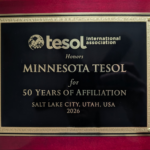

MinneTESOL June 2026 Newsletter Greetings MinneTESOL Members, My goal to bring the MinneTESOL board to full capacity is taking shape, and I am ecstatic to welcome our new Treasurer Pete…

 Marisa Nathan, a longtime educator of multilingual students and their teachers in MN and WI, and Sagal Sabrie, a current MLL teacher in St. Paul Public Schools and a student at Augsburg University, attended the 2026 TESOL International Advocacy Summit that was held in Washington, D.C., from June 22nd through June 24th. The Advocacy Summit is a three-day advocacy event that brings together educators and leaders from around the country to advocate for legislation, funding, and support for Multilingual learners (MLLs) in education. This experience provided a channel for collaboration with advocates from across the US and a space to explore the legislation and funding that impact our Multilingual learners. Key issues explored this year included seeking increased federal funding for the Department of Education, support for the continuation of the U.S. The Department of Education and to maintain the Office of English Language Acquisition (OELA) and its workforce at the federal level, support for the Sensitive Locations Act, and support for English Language Programs and International Education in higher education.
In our meetings with members of Congress, we shared our personal narratives to paint a clear, real picture of how legislation and funding affect the students and schools we serve. We extend our gratitude to MinneTESOL, TESOL International, and NABE for providing this opportunity to both expand our knowledge and voice our experiences and concerns. The workshop offered valuable insights from policy experts, union leaders, congressional staffers, and other experts in their respective fields. From these presenters, we learned the significant risk that federal education funding faces under the current political landscape. These presentations offered an opportunity to connect our personal school system and classroom experiences to the specific laws and bills that affect our work. As we move forward in our careers, the Advocacy Summit created a concrete step on a journey of advocacy beyond the classroom.
On the evening of Monday, June 22nd, we were warmly welcomed at TESOL International headquarters, where we met other advocates from around the country. This evening provided a welcoming space to share stories with other educators and explore the context of English education in other states. Additionally, we had the opportunity to engage in meaningful and inspiring conversations with various education leaders, including Montserrat Garibay, former Assistant Deputy Secretary and Director for the Office of English Language Acquisition and Senior Advisor for Labor Relations, Office of Secretary, U.S. Department of Education, U.S. Department of Education and current representative for Texas House District 49. We jumped into the role of advocates, exploring ways to apply our expertise in the political world.
On Tuesday, June 23rd, we began preparing for our congressional meetings. It was a busy day, beginning with an overview of policy updates from Jeff Hutcheson, TESOL Director of Advocacy and Public Relations, and Margarita Machado-Casas, NABE’s Western Regional Representative. Following this overview, Lina Lenia from UnidosUS and Julie Sugarman from the Migration Policy Institute gave a detailed presentation on the federal context of PreK-12 public education policy. This included information on the importance of advocating for Title III funding, the status of Title III, and how the grant is being minimized. We learned how in the U.S. The Department of Education is being dismantled along with the dissolution of OELA. They also included information about immigration enforcement and schools, ESSA waivers, and the Read Act and the importance of including oral language development, the use of background knowledge, biliteracy knowledge, and writing in addition to the foundational practices for our multilingual learners. This established the basis of our specific requests for our Congress members. Additional morning presentations included advocating for our newcomers and the federal context of adult education. In the afternoon, our focus was on higher education and on supporting our educators in the difficult context they work in. We wrapped up the day with a powerful and engaging story of personal resilience from Akbar Hossain, Secretary of Policy and Planning at the Pennsylvania Governor’s Office. Finally, Jon Bernstein of JNCL helped us prepare for the Hill visit with a workshop on how to be impactful when speaking with our representatives.
 On Wednesday, June 24th, advocates set off to Capitol Hill, where we prepared to meet with our Representatives to advocate for their support regarding education funding and legislation. We received folders with “leave-behinds” that included our primary “asks” and were prepped in the morning with breakfast by Jeff Hutchenson and a keynote from Montserrat Garibay. Ready to embark, we spent the rest of the day in the House of Representatives and Senate Buildings meeting with our Congress Members from Minnesota. This included meetings with education staffers from Rep. Ilhan Omar, Senator Tina Smith, and Senator Amy Klobuchar. In all of our meetings, support for our requests was evident. We will remain in contact with congressional staffers moving forward and hope to strengthen our relationships with our congressional teams to secure education funding and relevant legislation.
Our specific asks included:

 As we move forward, we would like to express our profound gratitude for this opportunity, provided by MinneTESOL, TESOL International, and NABE. This opportunity provided a crucial space to explore the legislation that directly impacts our students and the schools we serve. We emphasized the importance of the U.S. Department of Education’s Title I, II, and III funding under the ESEA, as well as the Protecting Sensitive Locations Act. Our meetings with congressional staffers and fellow advocates provided the foundation for long-lasting relationships with our congressional offices, ensuring continued advocacy for our Multilingual learners. We urge our fellow educators and advocates to join this important task of speaking up on behalf of our students, going beyond the classroom to advocate for change in our education and political systems.
Come see “Flirting Like an American” and meet other MinneTESOL members from around the Twin Cities metro area!
RSVP Here for the Post-Show Gathering from 6:45-8pm at Red Sea Ethiopian. Small bites are provided; drinks are on your own. Eat some yummy Ethiopian food and play BINGO for a prize! We hope you can make it!
Join us at the Great Minnesota Get Together! On Monday, September 7 (Labor Day), MinneTESOL representatives will be stationed at the Education Minnesota booth within the Education Building. Our team will engage fairgoers with questions from the U.S. Citizenship exam and distribute MinneTESOL-branded gifts to successful participants.
The MinneTESOL Conference brings together the brightest minds in ESL, Migrant Education, and Dual Language Immersion. As we celebrate our 50th anniversary, MinneTESOL is going back to our roots by rebranding the event from MELEd back to the MinneTESOL Conference. While the Minnesota Department of Education (MDE) will no longer provide direct funding for keynote speakers, they continue to support the conference through sessions and speakers focused on WIDA standards. The conference will be held Nov. 20-21 at the Saint Paul RiverCentre.
The MinneTESOL Call for Proposals is Open Now. We encourage educators to submit proposals and share their expertise. Registration will open in August.
The popular LAN ABE Summer Institute will be held virtually this year on August 12, 2026. Sponsored by the Literacy Action Network, this annual symposium offers essential professional development opportunities for Adult Basic Education practitioners. Comprehensive details regarding the Summer Institute are available online.

Welcome to Volume 42, Issue 1 of MinneTESOL Journal! While each article in this volume addresses diverse contexts, collectively this issue concerns access: access to academic texts, school systems, digital learning, and the professional knowledge teachers need to support learners within these contexts.
In “Language learning as educational partnership: A blended model for engaging multilingual immigrant Haitian families,” Amy Gooden and Louise Michelle Vital describe the English for Education and Empowerment Certificate Program, a university-school district partnership that supports Haitian immigrant parents’ English development and engagement in family-school partnerships.
In “Teaching English through TiNi: Integrating environmental education with language learning,” Douglas Anderson and Ana María Ángel Acuña describe the integration of TiNi – a UNESCO-recognized environmental education methodology – into English-language instruction over three years with 500 elementary students in a Latin American context. TiNi (Tierra de niñas, niños, y jóvenes para el buen vivir [Land of girls, boys, and youth for living well]) grants children small plots of land to nurture life and biodiversity while developing knowledge, skills, and values. The approach offers English as a second language (ESL) educators a model for meaningful, context-rich language learning that supports whole-child development while addressing multiple United Nations Sustainable Development Goals.
Name:
 Position at MinneTESOL: Central Regional Officer
Education context: Elementary English Learner (EL) Teacher in St. Cloud, Minnesota
Why you got into ESL: My passion for English began when I was a high school student. I loved learning the language, and I was inspired by my high school English teacher, who believed in me and encouraged me to grow. That experience showed me the powerful impact educators can have on students’ lives. As a former English learner and immigrant from Iraq, I became an EL teacher to help multilingual learners build confidence, achieve academic success, and develop a strong sense of belonging where they can thrive.
Current project: I am continuing my work in supporting multilingual learners and collaborating with educators through my role as Central Regional Officer for MinneTESOL. In this role, I look forward to building connections among EL educators, creating opportunities for collaboration, and supporting professional learning that strengthens the experiences of multilingual learners across Minnesota. I am passionate about advocating for inclusive learning environments where all students feel valued and have a sense of belonging.
Now is your chance to publish an article in the upcoming MinneTESOL Journal, a practitioner academic online journal. See Writing for the MinneTESOL Journal for more information.
Journal submissions are accepted on a rolling basis.
Past MinneTESOL newsletters can be found on our website, at http://minnetesol.org/minnetesol-newsletters
We are always looking for information to share from our members. Please send newsletter submissions to admin@minnetesol.org.